Data Protection Regulations UK: A 2026 Compliance Guide
Learn the core data protection regulations uk for 2026: UK GDPR, the DPA 2018, ICO powers, key obligations and cookie consent rules explained.
Regulators continue to receive large volumes of cookie complaints even though most major UK websites pass homepage compliance checks after regulatory engagement. That gap tells you almost everything you need to know about data protection regulations in the UK. Passing a surface check on a homepage does not mean your underlying data flows are compliant.
Most compliance failures don't happen because an organisation ignored privacy principles altogether. They happen because teams treat UK privacy law as a single rulebook, then apply the wrong track's controls to the wrong activity. General commercial processing, law-enforcement data, device cookies, and automated decision-making run on parallel statutory tracks, each with its own legal tests and audit paperwork.
The classification step matters more than the checklist. A marketing team that answers a cookie question with a UK GDPR lawful-basis analysis has already made the wrong move, because PECR governs device storage and access first. A public authority applying commercial consent standards to a statutory function has the same problem in reverse. Recent legislation has moved some of these boundaries, and the ICO's overview of the Data (Use and Access) Act 2025 sets out what the changes mean for organisations in practice.
If you're responsible for keeping a business, public body, or digital product on the right side of the ICO in 2026, you need a working map of which law governs what and what exact documentation an investigator will ask to see first.
The Four Rules That Govern Personal Data in the UK
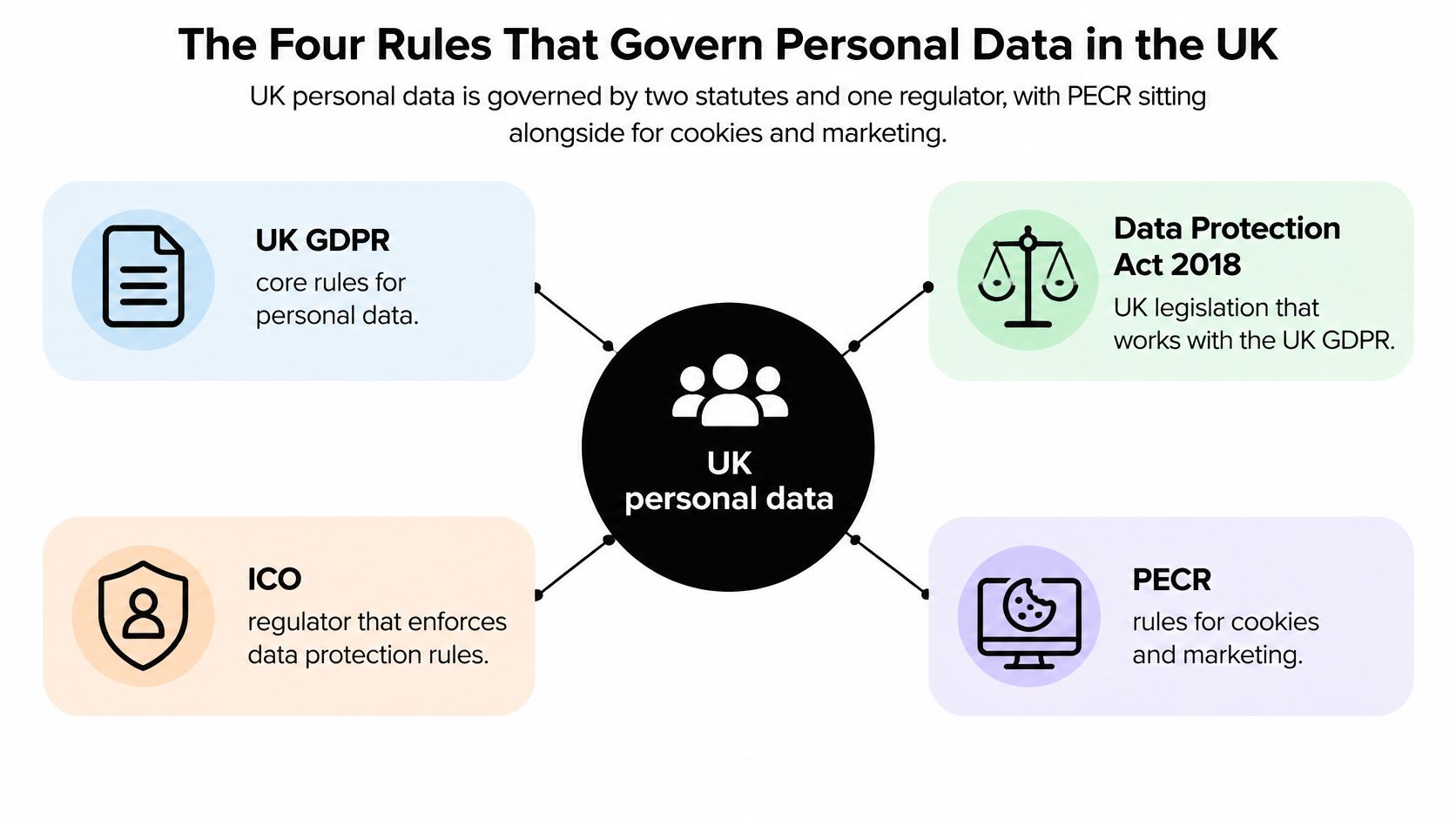
UK personal data is governed by two primary statutes and one regulator, with a separate set of electronic communications rules sitting alongside them for cookies and direct marketing. Understanding how those four pieces interlock stops teams from patching a tracking problem with a general privacy notice or applying commercial rules to statutory public functions.
Two Statutes, One Regulator, and a Parallel Track
Each pillar carries a distinct mandate inside the British legal system, and knowing their boundaries saves hours of misdirected legal review.
- UK GDPR: The core rulebook for most private and public sector personal-data processing. It sets out the seven foundational principles: lawfulness, fairness and transparency, purpose limitation, data minimisation, accuracy, storage limitation, security, and accountability.
- Data Protection Act 2018 (DPA 2018): Domestic legislation that works hand in hand with the UK GDPR. It adds UK-specific exemptions and creates standalone regimes for law enforcement, intelligence services, journalism, academic research, and children's data.
- Privacy and Electronic Communications Regulations (PECR): A parallel regime governing cookies, device storage, and electronic direct marketing. PECR operates on top of the UK GDPR rather than replacing it, so meeting one does not excuse ignoring the other.
- Information Commissioner's Office (ICO): The independent UK regulator responsible for overseeing, auditing, and enforcing this entire framework across both commercial and public-sector bodies.
Chronology, International Reach, and Unfinished 2025 Changes
The modern framework took shape in two distinct stages, as documented in the Explanatory Notes to the Data Protection Act 2018. The DPA 2018 replaced the older Data Protection Act 1998 and took effect on 25 May 2018, the exact day the EU GDPR began applying directly in the UK. After the Brexit transition period ended, the EU GDPR was brought into domestic law and amended to create the UK GDPR, which came into force on 1 January 2021.
That history matters far beyond London or Manchester. Organisations established outside Britain still fall inside the UK regime when they process UK residents' data, depending on the nature and location of their processing activities. Teams that want a clear primer for non-legal stakeholders on the underlying stakes can pair these statutory timelines with Trackingplan's guide on why data privacy matters.
One more wrinkle defines compliance in 2026. The Data (Use and Access) Act 2025 has amended targeted parts of the UK regime, notably around low-risk cookies, automated decisions, and formal privacy complaints. Because the ICO is still finalising updated guidance in those areas, treating UK data protection as static settled text is a quick way to build outdated controls.
How the UK GDPR, DPA 2018 and PECR Split the Work
The UK regime runs on parallel tracks. General processing, law enforcement, intelligence services, PECR cookies and PECR electronic marketing each carry their own controls. The first audit question is which track governs a data flow, and which artefacts that track expects a regulator to see.
| Instrument | Who it covers | Core obligation | Evidence a regulator asks for |
|---|---|---|---|
| UK GDPR (general processing) | Most private and public sector controllers and processors | Lawful basis, transparency, rights handling, security, breach reporting, accountability | Processing register, lawful-basis assessment, privacy notice, DPIA |
| DPA 2018 Part 2 | Controllers subject to UK GDPR, plus journalism, research and children's data exemptions | Supplies UK-specific rules, exemptions and the age-appropriate design context | Exemption justification, children's data assessment |
| DPA 2018 Part 3 | Competent authorities processing for law enforcement | Separate law-enforcement processing regime with its own rights and logging duties | Purpose classification, logs of processing, retention schedule |
| DPA 2018 Part 4 | Intelligence services | Bespoke regime with commissioner oversight | Commissioner oversight records, purpose classification |
| PECR Regulation 6 | Any operator storing or accessing information on a user's device | Clear information plus consent before non-essential cookies; strict-necessity exception | Consent records with policy version, timestamp, choice, vendor category and withdrawal event |
| PECR electronic marketing rules | Senders of electronic marketing | Consent or soft opt-in before direct marketing messages | Consent evidence, unsubscribe logs |
| ICO (regulator, not an instrument) | All of the above | Investigate complaints, audit, monitor compliance, enforce and fine | Response to information requests and audit questions |
Why One Enterprise Policy Breaks Under Scrutiny
One organisation often sits on several rows at once. A local authority can process resident portal logins under the UK GDPR, trading-standards case files under DPA 2018 Part 3, web analytics under PECR Regulation 6, and service emails under PECR marketing rules. A mid-sized retailer does a smaller version of the same split every day: UK GDPR for customer records, PECR for tags and email.
The ICO's Introduction to the DPA 2018 sets out those DPA regimes separately: Part 2 alongside the UK GDPR for general processing, Part 3 for law enforcement, and Part 4 for the intelligence services. PECR sits outside that Act and adds its own consent rules for device storage and electronic marketing. One enterprise privacy policy cannot carry all of those duties. Teams then apply a UK GDPR lawful basis to a Part 3 file, or they rely on legitimate interests to drop marketing tags that PECR only allows after opt-in consent.
Track confusion, rather than a missing principle, is the failure that a tidy policy pack still hides. Commercial UK GDPR controls on a PECR tracking problem, or on a Part 3 statutory duty, read cleanly until an investigator checks which regime actually governs the file.
Classify First, Configure Controls Second
Classify every processing activity before anyone picks a lawful basis, writes a retention schedule, or builds a rights workflow. Record three answers: controller or processor role, purpose, and applicable statutory regime. Put them in a central processing register that maps each flow to its legal track, personal-data categories, recipients, retention periods, and technical safeguards.
Take the local authority portal login. Role: controller. Purpose: account access for a resident service. Regime: UK GDPR and DPA 2018 Part 2, so the register points to a lawful-basis assessment, a privacy notice and a retention period for account data. The trading-standards prosecution file on the same resident is a different row: competent authority, law-enforcement purpose, Part 3, with processing logs and a Part 3 retention schedule. The analytics tag is a third row under PECR Regulation 6, evidenced by consent records, not by a legitimate-interests assessment.
Technical teams turning that register into database permissions, logging rules and access controls can cross-check the build against Freeform Company's privacy compliance checklist for IT teams. Once each system has a named regime, the incident workflow and the retention clock follow that row instead of a single company-wide default.
What the ICO Can Do and What Breaches Now Cost
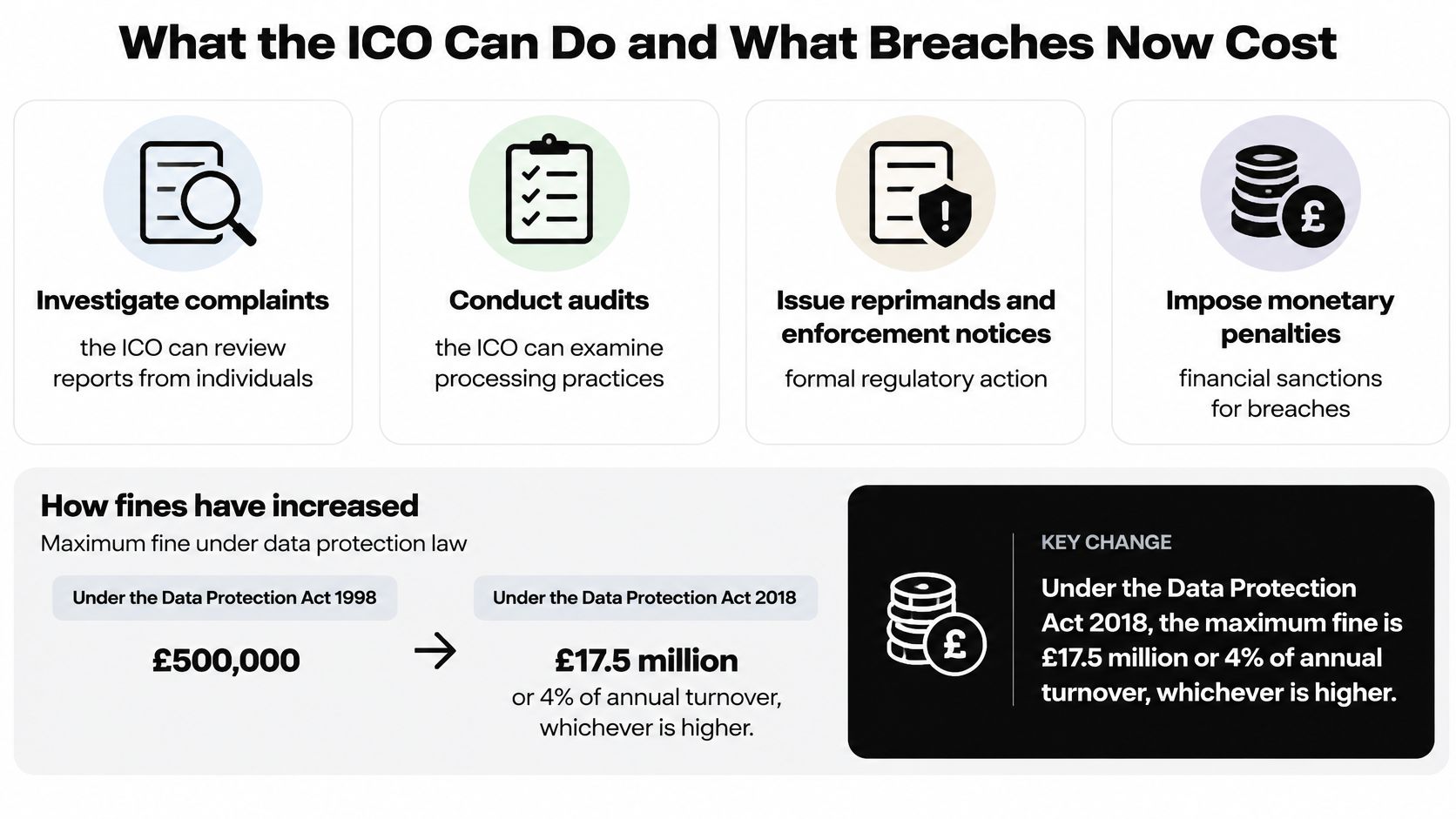
An ICO enforcement notice can interrupt trading before a fine reaches the board. The regulator can investigate complaints, audit live systems, issue public reprimands, require changes through enforcement notices, and impose monetary penalties. For a SaaS vendor or retailer, an order to stop processing or delete an unlawfully gathered marketing database can disrupt revenue-generating activity as well as create remediation costs.
From Fixed Statutory Caps to Turnover-Linked Sanctions
Under the Data Protection Act 1998, the maximum monetary penalty was generally £500,000; the ICO issued 22 monetary penalty notices totalling £3,010,610 in 2018-19, including two maximum £500,000 penalties, compared with 11 monetary penalty notices totalling approximately £1.29 million in 2017-18, including a £400,000 penalty against Carphone Warehouse, as recorded in the ICO's 2018-19 annual report and enforcement record.
Those figures describe enforcement under the older Act. They should not be treated as a forecast of exposure under the current framework, where serious UK GDPR infringements can attract turnover-linked sanctions.
| Regime and reporting period | Penalty structure | Illustrative enforcement |
|---|---|---|
| Data Protection Act 1998, 2018-19 | Fixed statutory ceiling | More notices and a higher aggregate total than the preceding year, including penalties at the ceiling |
| Data Protection Act 1998, 2017-18 | Fixed statutory ceiling | Included a penalty against Carphone Warehouse following a serious cyberattack |
The practical change is how a board should assess exposure. A fixed ceiling gives a large enterprise a bounded financial risk. A turnover-linked framework makes the scale of the undertaking relevant, while an enforcement notice can affect whether the underlying activity continues at all.
Why the Fine Is Only Part of the Bill
Compliance budgets also need to account for forensic incident response, required security remediation, customer notifications, legal defence, and commercial disruption. These costs can arise alongside a penalty. Their balance depends on what failed and what the organisation must change.
Consider a retailer facing questions about its marketing database and website tracking. Classify the conduct before estimating the consequences: database processing raises general data-protection questions, while cookie use needs its own PECR assessment. Evidence addressing the database does not, by itself, answer whether tracking was permitted. The same discipline applies when law-enforcement processing or automated decisions are involved: identify the relevant track before deciding which controls demonstrate compliance.
For an enforcement response, connect each disputed activity to the relevant records, security safeguards, and any required consent evidence. A generic privacy policy cannot explain those operational distinctions.
Read public enforcement trackers carefully, too. An unknown monetary figure is not zero, and a non-monetary order can still impose substantial operational constraints. Assess what the organisation was required to stop, delete, or change, alongside any published fine.
How to Build a Defensible Compliance Routine Step by Step
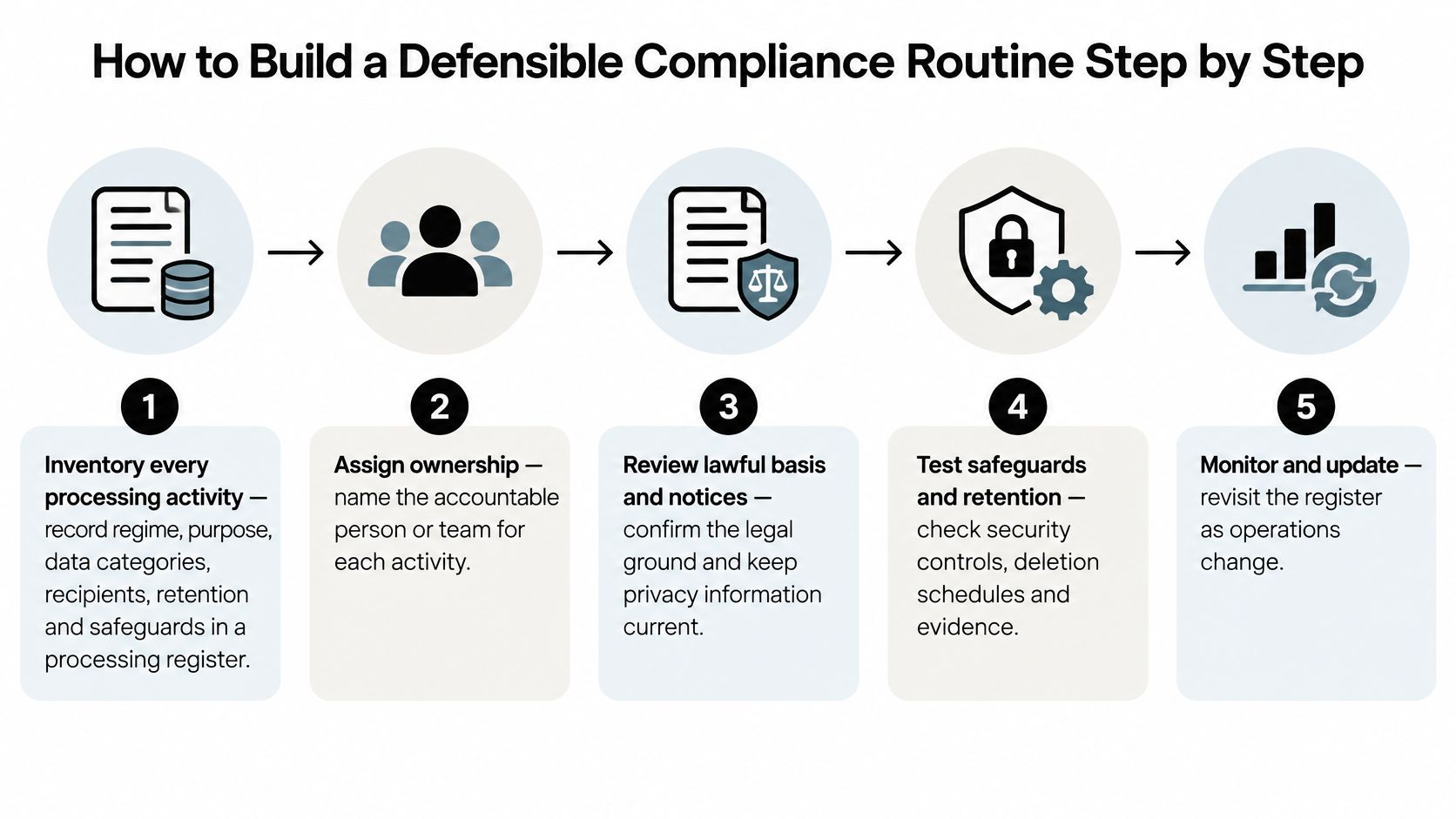
I'd build a UK privacy programme from the records outward rather than starting with website copy. Regulators rarely open an investigation by admiring a polished privacy policy; they ask for the internal register, assessments, and logs that prove your daily operations match what you told the public.
Seven Operational Steps and What Proves Each One
- Build a regime-classified processing register. Inventory every personal-data activity in a formal records of processing activities spreadsheet or privacy management tool, capturing your controller or processor role, legal track, purpose, data categories, recipients, retention periods, and security safeguards. The proof is the live register itself, updated with review dates. The classic failure is treating the register as a one-off spreadsheet from three years ago that no longer mentions your current CRM, analytics stack, or AI tools.
- Assign and document a lawful basis for every activity. Map each processing flow to one of the six UK GDPR lawful bases (consent, contract, legal obligation, vital interests, public task, or legitimate interests) before data collection starts. Where you rely on legitimate interests, produce a written Legitimate Interests Assessment (LIA) balancing your commercial need against user impact. Teams slip up by choosing consent for everything, only to realise they can't honour withdrawals inside core billing systems.
- Reconcile your privacy notice against the register. Publish clear user-facing notices explaining purposes, retention periods, third-party recipients, and international data transfers in plain English. Your evidence is a version-controlled notice archive tied directly to register line items. Copying a competitor's privacy template is the fastest way to expose mismatches during a complaint review.
- Stand up a tracked individual-rights workflow. Assign named owners and intake queues for access, rectification, erasure, restriction, portability, and objection requests, with strict statutory response clocks and a formal log whenever complex requests require an extension. Keep a request register recording receipt date, identity verification steps, exemptions applied, and closure date. Most breakdowns happen because support staff don't recognise an informal social-media or email request as a valid rights inquiry.
- Run Data Protection Impact Assessments (DPIAs) for high-risk processing. Before launching large-scale profiling, special-category health or biometric collection, or unfamiliar tracking technology, complete a signed DPIA that evaluates necessity, risks, and technical mitigations. Running the DPIA after the engineering team ships the feature turns a risk filter into rubber-stamp paperwork.
- Maintain an incident response and breach-logging procedure. Define clear internal escalation triggers, containment playbooks, and a rapid regulatory notification path alongside a breach register that records even non-reportable near misses. If an investigation arrives later, that register proves why you judged an incident low-risk rather than ignoring it.
- Train staff and audit systems against the register. Deliver role-specific privacy training for engineering, marketing, and support teams, then run periodic spot checks comparing real production databases and tag managers against your documented inventory. Training attendance logs and audit findings prove ongoing accountability; annual tick-box slide decks that never touch actual job workflows don't.
Audit reality check: An ICO investigator almost always asks for your processing register, lawful-basis records, and DPIA history before debating the wording of your public privacy policy.
Worked Scenario for Three High-Risk Website Flows
Say a mid-sized online retailer wants to tighten compliance without stalling its product roadmap. Rather than trying to fix forty minor back-office processes at once, the compliance lead picks the three highest-risk customer-facing flows and builds the full artefact set for each:
- Website analytics: Classified under both PECR Regulation 6 and UK GDPR. The artefact set includes a vendor data-flow diagram, a consent-platform trigger rule showing tags stay blocked until opt-in (or a written low-risk exemption assessment where applicable), retention settings inside the analytics tool, and matching disclosures in the cookie notice.
- Advertising and retargeting tags: Strictly non-essential under PECR and high-risk profiling under UK GDPR. The retailer maintains a tag-manager audit log, granular consent logs tied to each ad-tech vendor, a completed DPIA covering cross-site tracking, and updated processor or joint-controller contracts.
- Email newsletter list: Governed by PECR marketing rules alongside UK GDPR. The evidence bundle holds timestamped opt-in or soft opt-in capture logs, the exact wording shown at signup, automated suppression lists proving instant unsubscribes, and a retention rule pruning inactive subscribers.
Pick your own three highest-risk activities and finish steps one through three for them before expanding across lower-risk internal systems.
Cookie Consent Under PECR and the New Low-Risk Exemption
Many teams still treat cookie compliance as a front-end UI ticket: install a consent banner, add an "Accept all" button, and move on. That mindset explains why public complaints remain stubbornly high even on sites whose homepages look compliant on the surface. The deeper problem is a classification error. PECR is a separate track running parallel to UK GDPR, with its own trigger, its own consent standard, and now its own exemption, and most failures I see come from applying the wrong track's controls rather than missing a principle altogether.
The PECR Regulation 6 Baseline
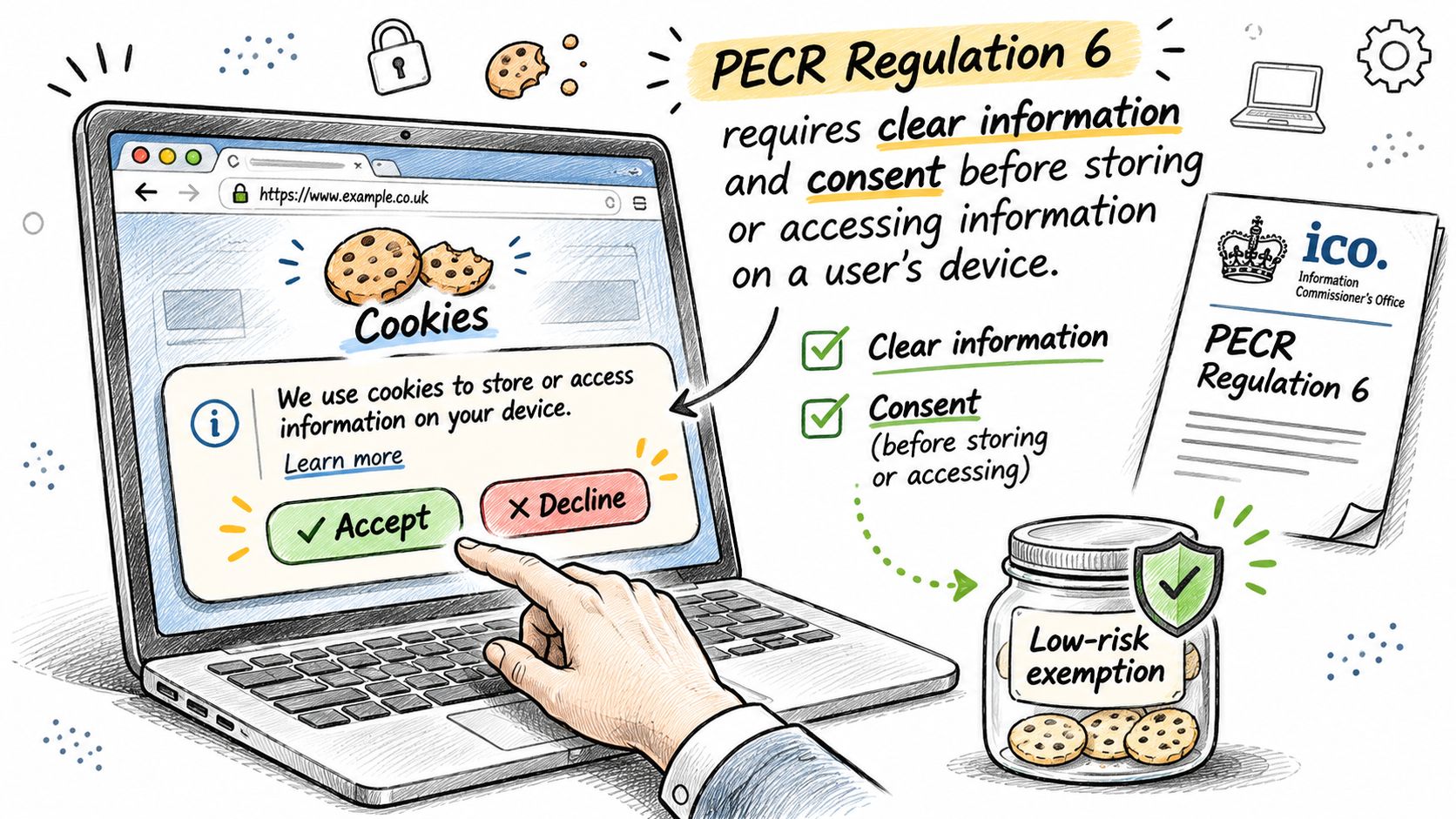
Under Regulation 6 of PECR, as set out in the ICO's guide to cookies and similar technologies, you generally can't store or access information on a user's device without providing clear information and obtaining consent that is freely given, specific, informed, and expressed through unambiguous positive action. The core technical exception covers technologies strictly necessary to provide a service the user explicitly requested, such as keeping items in an online shopping basket or running security checks during online banking.
The trigger is storage or access on the device, not the sensitivity of the data. That distinction matters. A team that classifies a pixel as "low-risk analytics" under UK GDPR and concludes consent is optional has applied the wrong track: PECR asks a different question first, and its answer controls whether the script may fire at all.
Everything outside strict necessity, including standard analytics, advertising pixels, and cross-site tracking tags, must stay blocked by default until a consent signal is recorded, subject to the narrow low-risk exemption discussed below. Interfaces also have to make refusing and later withdrawing consent just as easy as accepting it, without dark-pattern friction.
To prove compliance if challenged, configure your consent management platform (CMP) to preserve five fields for every decision: the policy version shown, the exact timestamp, the user's granular choice, the vendor or category affected, and any subsequent withdrawal event. Capturing valid PECR consent to place a tracker doesn't eliminate your separate UK GDPR obligations around transparency, lawful basis, minimisation, retention, and cross-border data transfers for the personal data those scripts subsequently collect. The two tracks run in parallel, and passing one tells you nothing about the other.
Navigating the 2025 Low-Risk Exemption Without Guessing
The Data (Use and Access) Act 2025 introduces a targeted shift by allowing certain storage and access technologies to run without explicit consent in specified low-risk situations. The catch for teams operating in 2026 is timing: the Act's boundaries for these technologies are still being turned into detailed guidance, so the precise scope of what qualifies as low-risk remains unsettled in practice.
Relying on a flat list of cookie names won't survive scrutiny while that guidance evolves. A script's risk profile depends on how it is configured and where its data goes, not on its label. Classify every script, pixel, local-storage item, and mobile SDK using six concrete criteria:
- Specific purpose: Separate essential session security from aggregated site measurement and individual behavioural profiling.
- Data flows: Trace where collected identifiers travel, including server-side tag containers and downstream data warehouses.
- Third-party vendors: Identify every external party receiving payloads and whether they combine your data with other clients' audiences.
- Identifier persistence: Document whether the technology uses short-lived session tokens or persistent cross-session device IDs.
- Downstream sharing: Verify whether measurement data stays strictly isolated for internal reporting or feeds ad-auction platforms.
- Reversibility and user control: Confirm that users can easily opt out or clear stored values without breaking core site functionality.
Keep the finished assessment in writing for each technology, since it is the document a regulator would request first if it questions why a script ran without consent. Until the detailed guidance settles, I would treat any borderline call as consent-required rather than exempt, because the cost of a conservative default is a banner impression while the cost of a wrong exemption call is an enforcement file with no supporting analysis.
Audit Beyond the Homepage Banner
Homepage consent banners hide plenty of silent compliance failures. Marketing teams frequently drop new pixels into Google Tag Manager without updating CMP blocking rules, leaving tags firing on checkout funnels, regional landing pages, or embedded iframes. Mobile apps present an even bigger blind spot because third-party advertising and crash-reporting SDKs often collect device identifiers on launch before any consent modal appears.
Run automated crawls and manual browser-network inspections across deep pages, logged-in account areas, and mobile builds every quarter. Documenting what fires in the network tab, rather than what your banner claims to block, is what separates real PECR compliance from cosmetic compliance.
Automated Decisions and the New Complaints Process
Headlines around the Data (Use and Access) Act 2025 often describe the legislation as a straightforward relaxation of UK GDPR controls on artificial intelligence and automated profiling. That reading is dangerous for compliance teams. According to UK Government guidance on the Data (Use and Access) Act 2025, the Act does create a more permissive framework for solely automated decisions carrying legal or similarly significant effects, yet the ICO has explicitly flagged automated decision-making and profiling as areas requiring new or updated regulatory guidance.
Greater legal flexibility doesn't automatically shrink your compliance budget. It shifts the workload from securing upfront permission to proving explainability, operational safeguards, and real human redress after a decision is made.
What to Document Before Final ICO Guidance Lands
If your organisation runs automated CV screening, credit scoring, insurance underwriting, fraud blocking, or customer-facing generative-AI workflows, waiting for final guidance leaves you exposed. Assemble six pieces of evidence now while systems are being built or procured:
- Necessity and proportionality memo: Explain why automated processing is used for the decision, what alternatives were considered, and how outcomes affect individuals.
- Human-involvement protocol: Define who reviews contested or edge-case decisions and prove those reviewers have the authority and context to overturn the algorithm rather than rubber-stamping a score.
- Contestability workflow: Document the exact channel an affected person uses to challenge an automated outcome, receive meaningful information about the logic involved, and request human review.
- Bias and accuracy testing records: Keep pre-deployment and periodic evaluation reports checking for disparate errors across demographic groups or edge-case populations.
- Model change log: Track version updates, training-data refreshes, threshold adjustments, and prompt modifications so you can reconstruct why a system made a particular decision six months ago.
- Supplier accountability terms: Lock vendors into contractual duties covering model transparency, sub-processor disclosures, audit support, and incident alerts before signing off on third-party AI tools.
Turning Privacy Complaints Into a Service Operation
The 2025 Act also introduces a statutory duty for controllers to maintain a formal data-protection complaints process, enabling individuals to complain directly to your organisation before escalating to the ICO. That change moves privacy compliance away from passive disclosure pages and into active service operations.
You'll need dedicated intake channels (such as a monitored privacy web form and email queue), triage rules separating routine customer support from statutory privacy complaints, named response owners, evidence-preservation steps so relevant logs aren't overwritten, and clear internal escalation routes to legal or senior leadership.
Treat every direct privacy complaint as an early-warning audit. Fixing a broken opt-out or an unexplained automated rejection internally is vastly cheaper than defending it to the ICO.
Territorial Scope and Cross-Border Transfers
These automated-decision and complaint-handling duties follow the people whose data you process, not just your company's country of incorporation. An organisation established outside Britain can still fall under UK GDPR obligations whenever it offers goods or services to individuals in the UK or monitors their behaviour online.
Before approving any overseas SaaS vendor, AI API, or analytics platform that touches UK personal data, check the international transfer track too. Confirm whether the destination country benefits from a UK adequacy regulation or whether you need a formal transfer safeguard, such as the UK International Data Transfer Agreement (IDTA) or the UK Addendum to EU Standard Contractual Clauses, backed by a transfer risk assessment.
Where the Misconceptions Come From
The single most damaging belief in UK privacy compliance is that one well-written privacy policy covers everything an organisation does with personal data. It doesn't, because a public notice describes processing without classifying which legal track governs each data flow, which lawful basis applies, or what retention and logging duties sit behind it. A regime-classified processing register fixes that disconnect at the source.
Run a quick three-question diagnostic on your own operations today:
- Pick three live processing activities. Choose one customer-facing web tracker, one marketing workflow, and one core operational or HR dataset, then write down the exact statutory track governing each.
- Check the paper trail against the live system. Open your privacy notice, your consent logs, and your database retention settings, and verify whether all three match the track you just named.
- Trace your cross-border and hidden surfaces. Confirm whether UK requirements apply to overseas entities handling UK residents' data, and inspect tag managers or mobile apps beyond the homepage banner to see whether third-party scripts fire before consent.
If any answer creates hesitation, use this quick reference to close the gap.
| Misconception | Correction | Fix |
|---|---|---|
| UK GDPR is the only relevant law | PECR and DPA 2018 Parts 3 and 4 are separate regimes | Classify each processing activity by regime in the register |
| Brexit ended GDPR obligations for UK firms | UK GDPR applies domestically; foreign organisations processing UK residents' data can still be caught | Check whether UK requirements apply to each data flow, wherever the entity is established |
| A consent banner is cookie compliance | Concerns persisted in 2025-26 despite near-universal homepage compliance | Audit tag managers, mobile apps and third-party tags, not just the banner |
| The 2025 Act relaxed everything | Automated-decision rules are more permissive but documentation and a complaints process are added | Document necessity, safeguards, contestability and complaint intake now |
| Unknown fine amounts mean no penalty | Unknown is not zero; shared obligations are attributed once | Read enforcement records by payment category and attribution, not headline totals |
| One privacy policy covers all processing | Different regimes demand different lawful bases, rights and retention | Reconcile the privacy notice against the classified register |
Your Next Step Before the Next ICO Letter
Strong compliance programmes rarely come from sweeping six-month rewrites that stall before launch. They come from completing five concrete tasks in sequence so your highest-risk tracks are defensible before a user complaint or regulatory inquiry arrives.
- Classify your top three risks. Build or update a regime-classified processing register covering your three highest-risk data flows first, naming the legal track, role, lawful basis, retention rule, and security controls for each.
- Reconcile public notices with real systems. Line up your privacy notice, cookie disclosures, consent records, and automated deletion schedules against that register so nothing contradicts what your engineering stack runs.
- Instrument provable consent logging. Configure your consent management platform to capture policy version, timestamp, user choice, vendor category, and withdrawal events, and verify via browser network checks that non-essential tags stay blocked until opt-in.
- Stand up complaints and breach paths early. Launch your direct privacy-complaints intake channel, assign triage owners, and test your incident-escalation workflow and breach register during a calm week rather than mid-crisis.
- Benchmark real enforcement decisions in your sector. Base your risk prioritisation on how regulators penalise tracking, security, and transparency failures rather than internal assumptions or media headlines.
Using Enforcement Records Without Misreading the Data
When you benchmark UK risk, rely on structured primary records rather than aggregated rumour. Official ICO enforcement pages, legal trackers such as GDPRhub and the CMS Enforcement Tracker, and non-commercial research compilations like Cookie Fines all help teams review published authority actions and court decisions. Cookie Fines filters published records by region, confirmed legislation, and privacy topic (including cookies and tracking as well as security breaches), separates fines from settlements and other payments, flags unknown values instead of recording them as zero, and keeps UK GDPR actions distinct from EU GDPR totals. Like any research compilation, its coverage varies by source, and historical cases aren't legal advice or a prediction of future fines.
Stop treating data protection regulations in the UK as one uniform rulebook. Map your parallel tracks, fix the processing register first, and make every notice, banner, and AI safeguard answer to that register.
If you're benchmarking how the ICO and other regulators treat cookie violations, security breaches, and transparency failures, Cookie Fines offers a non-commercial database of published privacy enforcement records filtered by jurisdiction, confirmed legislation, and privacy topic. It keeps UK GDPR actions separate from EU GDPR totals, distinguishes fines from settlements and unknown values, and gives compliance teams structured precedent for internal risk reviews.